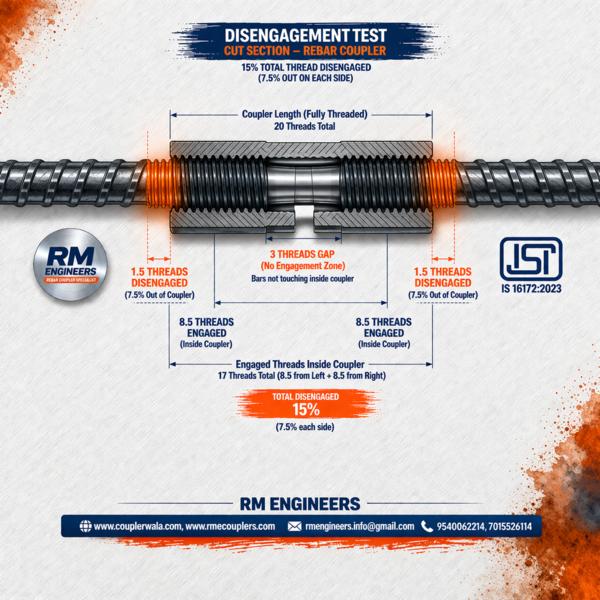

Understanding technical terminology is essential for engineers, contractors, manufacturers, and quality inspectors working with reinforcement couplers. As defined under Indian Standards (IS), particularly IS 16172:2023, specific terms clarify the requirements and performance expectations of mechanical splicing systems.
This guide explains key terminology related to mechanical splices, reinforcement couplers, testing methods, and slip measurement, helping professionals ensure compliance, quality, and structural safety.
1. Mechanical Splice
A Mechanical Splice refers to the complete assembly of a coupler, including any additional intervening material or components, used to join two reinforcing bars.
Key Points:
-
Provides a mechanical connection between rebars
-
Transfers tensile and compressive forces
-
Eliminates the need for traditional lap splicing
-
Improves structural performance and reduces congestion
Mechanical splices are widely used in high-rise buildings, bridges, precast structures, and seismic-resistant construction.
2. Reinforcement Coupler
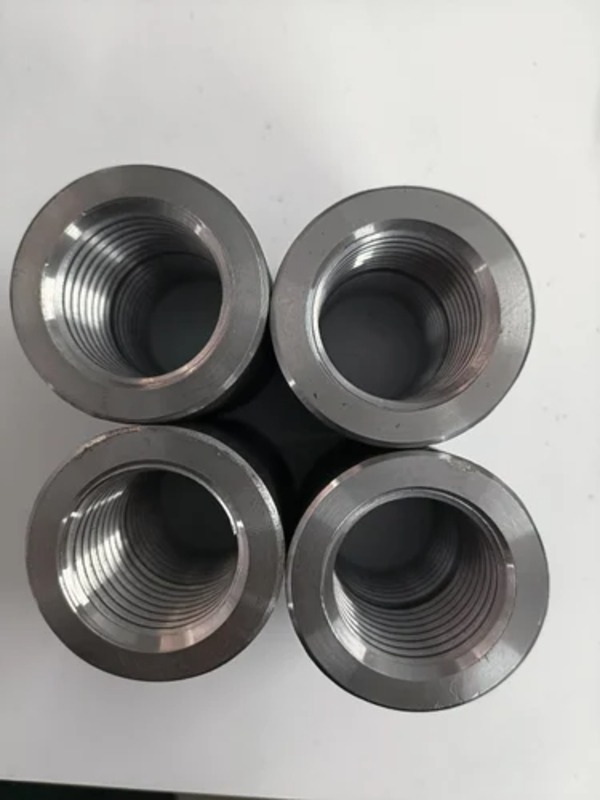
A Reinforcement Coupler is a coupling sleeve, threaded coupler, or hybrid coupler used to mechanically splice reinforcement bars.
Purpose:
To transfer axial tensile force and compressive force from one bar to another safely and efficiently.
Types of Reinforcement Couplers:
-
Threaded Couplers
-
Sleeve (crimped) Couplers
-
Hybrid Couplers
These couplers are designed to ensure load continuity and maintain structural integrity across rebar joints.
3. Coupler Length
Coupler Length is defined as the actual length of the reinforcement coupler, including:
-
All load-transferring components
-
Lock nuts (if provided)
-
Any additional structural parts
This measurement is important for installation planning and structural detailing.
4. Length of Mechanical Splice
The Length of Mechanical Splice is calculated as:
Coupler Length + 2 × Nominal Bar Diameter (at both ends)
This is a conventionally accepted definition used to account for the affected stress zone near the splice region.
Why It Matters:
-
Helps engineers evaluate stress distribution
-
Assists in structural detailing
-
Ensures compliance with standard design practices
Although approximate, this method provides a practical way to assess the effective influence zone of the splice.
5. Slip
Slip refers to the permanent extension of a mechanical splice after it has been subjected to a defined load level.
Importance of Slip Measurement:
-
Indicates joint performance under load
-
Evaluates deformation behavior
-
Ensures safety and serviceability
Excessive slip can compromise structural stability, making it a critical performance parameter.
6. Slip Measurement Device
A Slip Measurement Device consists of:
-
An extensometer
-
A fixing system attached to the mechanical splice
This assembly measures permanent extension accurately during testing.
Purpose:
-
Verifies compliance with standard limits
-
Measures deformation under tensile loading
-
Ensures reliable performance data
7. Testing of Reinforcement Couplers
Testing plays a crucial role in ensuring the quality and performance of mechanical splices.
7.1 Type Tests
Type Tests are conducted to prove conformity with the standard.
These tests are required:
-
For product or type approval
-
When there is a change in:
-
Coupler design
-
Manufacturing process
-
Crimping method
-
Forging process
-
Threading machine or technique
-
Type testing ensures that any design or production modification maintains compliance and performance standards.
7.2 Acceptance Tests
Acceptance Tests are performed on samples taken from a production lot that has already passed type testing.
Purpose:
-
To approve or reject a specific batch
-
To verify consistent manufacturing quality
-
To ensure each lot meets standard performance criteria
Acceptance testing protects project quality by preventing substandard products from reaching construction sites.
Why Terminology Matters in Construction Projects
Understanding these standardized definitions helps:
✔ Structural engineers ensure correct design calculations
✔ Quality inspectors verify compliance
✔ Manufacturers maintain standard production
✔ Contractors achieve proper installation
✔ Project managers ensure regulatory approval
Using correct terminology also improves documentation, tender submissions, and technical communication across stakeholders.
Conclusion
Clear understanding of Mechanical Splice, Reinforcement Coupler, Slip, Coupler Length, and Testing Procedures is essential for ensuring structural safety and compliance in reinforced concrete construction.
By adhering to definitions provided under Bureau of Indian Standards and IS 1786, construction professionals can maintain quality, durability, and performance in reinforcement splicing systems.
Whether you are a manufacturer, structural consultant, or contractor, mastering these terms ensures better execution, improved safety, and full regulatory compliance in modern infrastructure projects.
We are the leading manufacturer and supplier of Reinforcement Couplers in Faridabad