

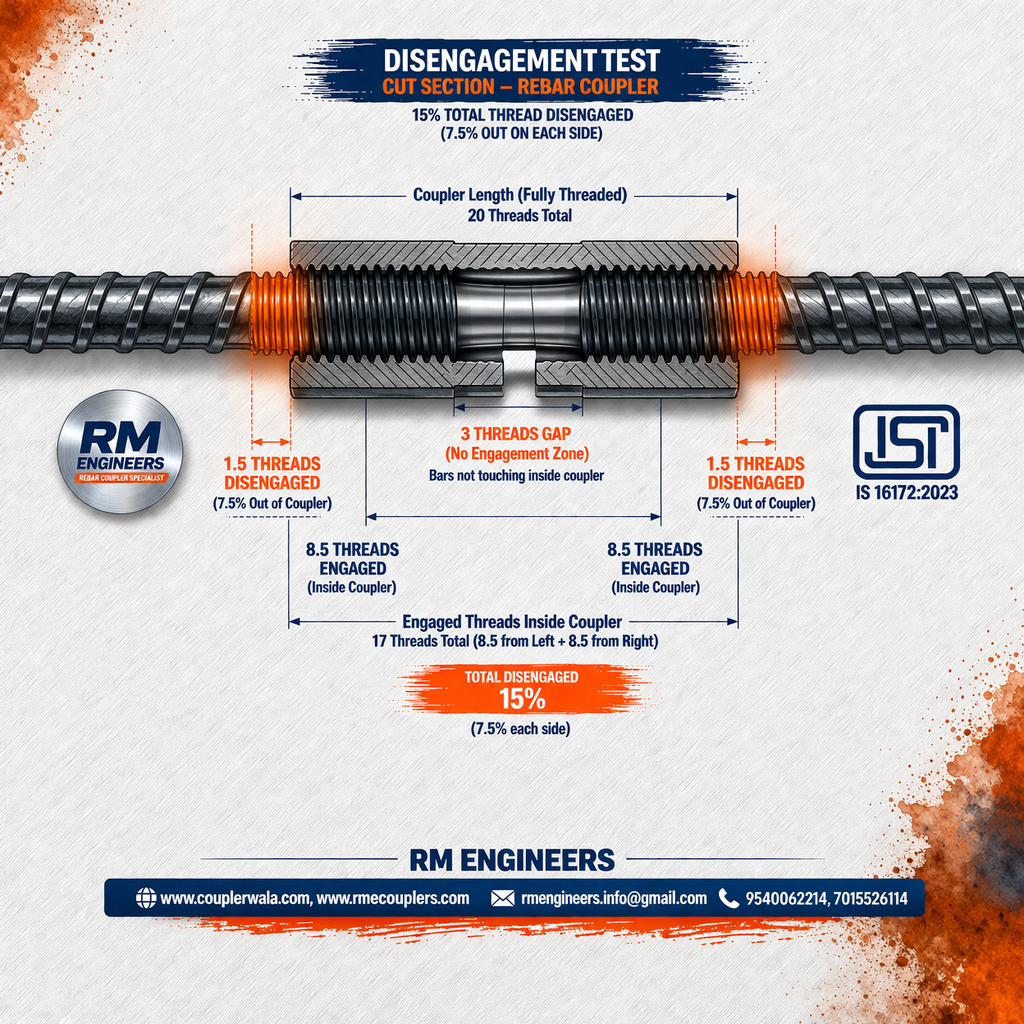
In modern reinforced concrete construction, rebar couplers play a critical role in ensuring structural continuity and strength. Among the various quality checks specified in IS 16172:2023, the Disengagement Test for Threaded Couplers is essential to verify the robustness of the threading system under imperfect installation conditions.
This blog explains the concept, requirement, procedure, and significance of the disengagement test.
________________________________________
🔍 What is the Disengagement Test?
The disengagement test evaluates the performance of a threaded rebar coupler when a portion of the threaded engagement is intentionally reduced.
This simulates real-world site conditions, where improper tightening or threading errors may occur.
________________________________________
📘 Clause Reference: IS 16172:2023 (Clause 9.2.1.1)
As per the code:
The safety margin in threading of reinforcing bar and coupler design shall be such that required performance for static tensile test as per Annex B is ensured even if 15% of the total thread length is not engaged.
Key Requirement:
• Total thread disengagement: 15%
• Distribution:
• 7.5% disengaged from each side of the coupler
• Even under this condition, the joint must pass the static tensile test
________________________________________
⚙️ Why is This Test Important?
• Ensures safety under imperfect installation
• Verifies threading design margin
• Confirms load transfer capability
• Prevents structural failures due to partial engagement
________________________________________
🧪 Test Procedure (Simplified)
1. Prepare the specimen
• Two rebars connected using a threaded coupler
2. Introduce disengagement
• Reduce thread engagement by:
• 7.5% from one side
• 7.5% from the other side
3. Mount in tensile testing machine
4. Apply tensile load
• As per Annex B of IS 16172
5. Evaluate performance
• The joint must meet tensile strength requirements
• Failure should ideally occur in the bar, not the coupler
________________________________________
✏️ Sketch of Disengagement Condition
<------ Coupler Length ------>
______________________________________
| |
| Threaded Coupler Body |
|______________________________________|
|<-- engaged -->| |<-- engaged -->|
| | | |
| | | |
| | | |
____|_______________|_|_______________|____
↑ ↑ ↑ ↑
7.5% Center 7.5%
disengaged disengaged
Left Rebar Right Rebar
Explanation:
• The total threaded length is partially disengaged
• Equal disengagement (7.5%) is maintained on both ends
• Remaining engaged threads must still ensure full strength performance
________________________________________
🏗️ Acceptance Criteria
The coupler joint must:
• Pass the static tensile test
• Achieve required ultimate tensile strength
• Exhibit ductile failure (preferably in rebar, not coupler)
________________________________________
💡 Practical Insight
This test reflects a worst-case installation scenario, ensuring that even if:
• Threads are not fully tightened
• Minor human error occurs
…the system still performs safely.
________________________________________
🛡️ RM Engineers Guarantee
At RM Engineers, we stand by the quality and reliability of our rebar couplers.
✔ Guaranteed compliance with IS 16172:2023
✔ Successfully meets disengagement test requirements
✔ Designed with adequate thread safety margins
✔ Tested for real-site performance conditions
👉 Our assurance: Even with 15% thread disengagement, RM Engineers couplers deliver the required tensile performance without compromise.
________________________________________
🔚 Conclusion
The Disengagement Test (Clause 9.2.1.1) is a crucial benchmark in ensuring the safety and reliability of threaded rebar couplers. It validates that even under partial engagement conditions, the coupler system performs effectively.
For engineers, contractors, and quality inspectors, understanding and complying with this test ensures structural integrity, safety, and long-term durability.
RM Engineers provide rebar couplers@locations and In-house lab is always open.